

• In November 2024, UAE formally amended its VAT law (via Federal Decree-Law No. 16 of 2024, along with complementary changes) to legally recognise electronic invoices and credit notes (“e-invoicing”) as valid tax documents.
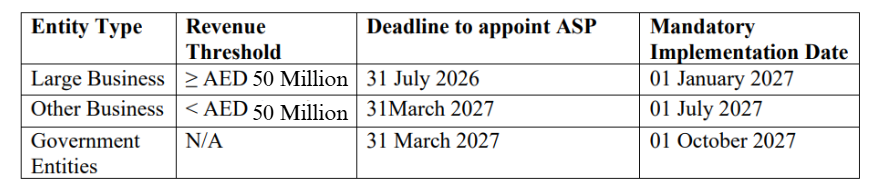
• The official e-invoicing framework is governed by Ministerial Decision No. 243 of 2025 and Ministerial Decision No. 244 of 2025 which set out the requirements, scope and phased implementation schedule.
Deadline:
Merits of E-Invoicing in the UAE
1. Enhanced Tax Compliance & Transparency
• Minimises errors, fake invoices, and fraud.
• Enables real-time or near real-time reporting to the FTA.
• Strengthens the overall VAT compliance ecosystem.
2. Faster and More Efficient Processes
• Eliminates manual paperwork and physical storage.
• Reduces time spent on invoice creation, approval, and reconciliation.
• Automates repetitive tasks, reducing administrative burden.
3. Improved Accuracy
• Standardised formats reduce human error.
• Auto-validation prevents incomplete or incorrect data entry.
4. Better Cash Flow Management
• Faster invoice processing leads to quicker payments.
• Improved tracking of receivables and payables.
5. Cost Savings
• Cuts printing, courier, storage, and archiving costs.
• Lowers the cost of compliance in the long term.
6. Stronger Audit Trail
• Digital records simplify audit procedures.
• Easier for auditors and tax authorities to verify transactions.
7. Integration With Business Systems
• Can be integrated with ERPs, accounting systems, and POS systems.
• Enhances efficiency in high-transaction industries.
8. Environmental Benefits
• Reduces paper consumption and carbon footprint.
Demerits / Challenges of E-Invoicing
1. Initial Setup Costs
• Upgrading ERP or accounting software.
• Installation of Accredited Service Providers
• Training staff and adapting processes.
2. Technical Complexity
• Smaller businesses may struggle with implementation.
• Need for stable internet and proper IT infrastructure.
• Managing updates and ensuring the system is compliant with FTA requirements.
3. Cybersecurity Risks
• As data is stored electronically, businesses must ensure:
o Data encryption
o Secure backups
o Protection against hacking or data breaches
4. Dependence on Technology
• System downtime or failures can disrupt invoicing.
• Need for continuous monitoring and technical support.
5. Compliance Burden for Small Entities
• Small firms with limited resources may find the mandatory compliance demanding
and challenging.
Conclusion
The UAE’s move to e-invoicing is a major step toward digital transformation, tax
transparency, and ease of doing business. While the benefits are significant particularly in
compliance, efficiency, and auditability businesses need to prepare for the initial costs,
system upgrades, and proper training.
Disclaimer: Content posted is for informational and knowledge sharing purposes only, and is not intended to be a substitute for professional advice related to tax, finance or accounting. The view/interpretation of the publisher is based on the available Law, guidelines and information. Each reader should take due professional care before you act after reading the contents of that article/post. No warranty whatsoever is made that any of the articles are accurate and is not intended to provide, and should not be relied on for tax or accounting advice.
Contributor
CA. Joseph Philip, BCom, FCA, MBA
Managing Partner – Stuart & Hamlyn, Chartered Accountants
A Fellow Chartered Accountant with over 25 years of experience in audit, business consultancy, due diligence, feasibility studies, business risk and control reviews, accounting, and company formation. Currently serving as Country Managing Partner at Stuart & Hamlyn, a global Chartered Accountancy firm with offices in the UAE, India, and USA.
Previously held senior roles at Fuller International, ITL Cosmos, and Esquare Polymers, gaining expertise in internal audit, credit control, and financial management. Known for delivering professional services with a personal touch, Joseph specializes in audit & assurance, tax consulting, business valuation, forensic audit, SAP consulting, and outsourcing solutions.
Related Posts

What businesses should know on the updated VAT Refund Rules which will be effective from 01 January...
Read More
@@PLUGINFILE@@/ttsmaker-file-2025-9-4-14-44-44.mp3Listen to this ArticleWhen the UAE first introduce...
Read More
IntroductionE-Invoicing, or electronic invoicing, refers to the generation, transmission, and r...
Read More