
Every four years, the world casts its eyes to the global stage. What started as curiosity about football economics slowly turned into an enquiry into the hidden financial ecosystem surrounding the world's biggest sporting event. This topic has now made its third appearance in my life. First as a college presentation (2018), second as a potential topic for my dissertation (2023), and now as a relaxed recollection of thoughts and ideas. Every iteration of the World Cup has taught me to look at a new dimension of this topic and I hope this one makes for a good read. This is the World Cup through the lens of a football fan and an AML professional.
Let's start from scratch - why did this topic intrigue me in the first place? My intrigue - and the reason for choosing to present this in college (completely voluntarily) in 2018 - stems back to 2014, probably the first time I saw the World Cup as more than just a few games of football, and more like the cultural phenomenon it really is. The hosts were Brazil, the most successful nation with 5 stars across their chests and the atmosphere was that of a carnival. Once the curtains were drawn and the festival had ended, the country showed signs of struggle. Within a few years, the $550 million, 72,000-seat Arena BRB Mane Garrincha Stadium (I had to Google that) located in the capital of Brazil was converted into a Bus Depot. A great article by The Athletic provides a first-hand account of their visit
in 2020 and also a hopeful future for the stadium.
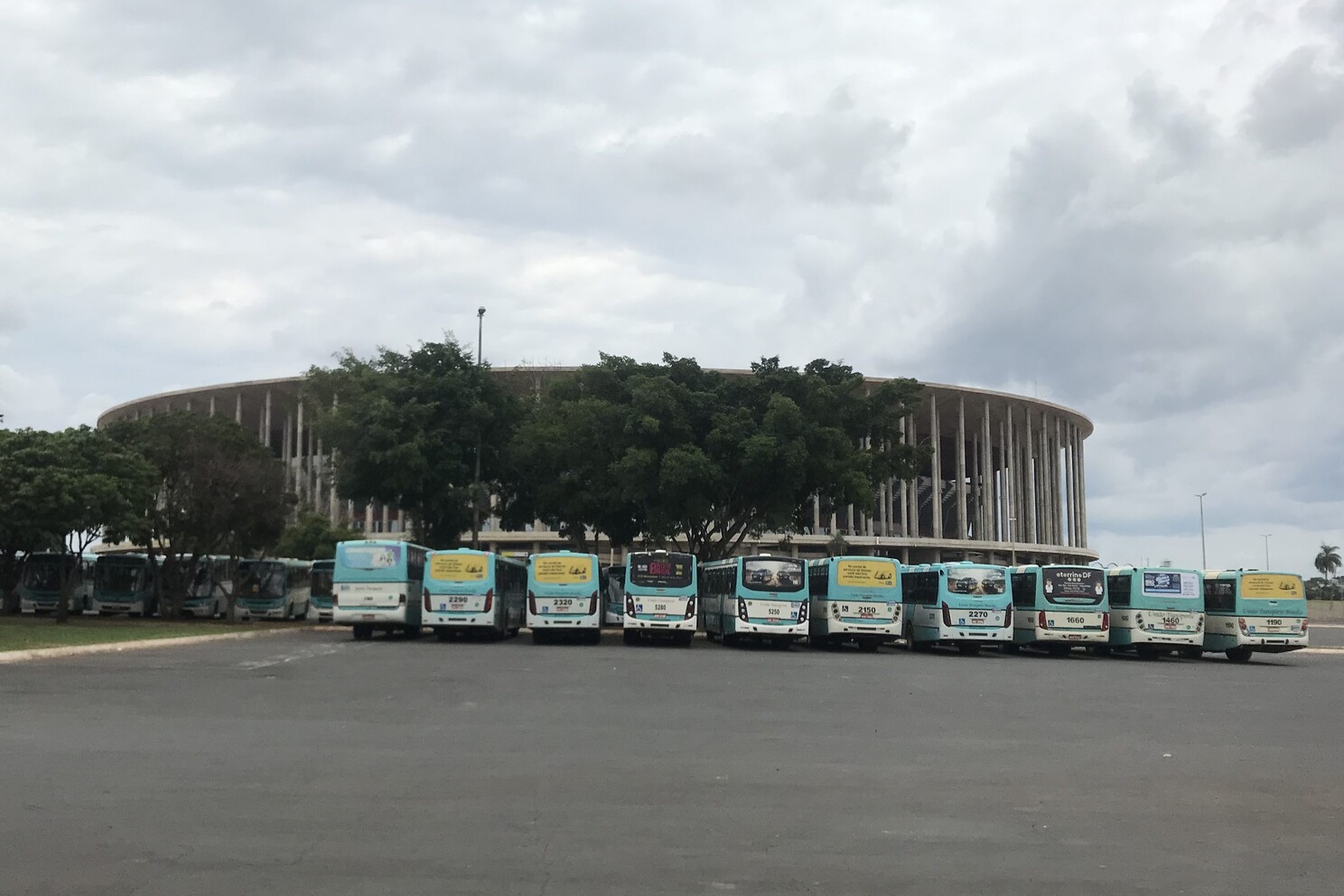
Arena BRB Mane Garrincha Stadium in Brasilia being used as a Bus Depot (2020). Credits : Jack Lang, The Athletic
This wasn't the only stadium that faced such a fate as Arena Pantanal in Cuiaba was temporarily converted into a parking lot and was criticized as a "white elephant" - a costly burden, with no future viable use.
This in turn drove me to look into why any country would even want to host a World Cup if this is what it's left with. Let's get the obvious out of the way - tourism, creation of new jobs, better infrastructure all around and obviously, prestige. Political powerplay also is at work here, and winning such a bid shows that the host country is safe, modern and stable. Financially? World Cups have always been an expense rather than an investment. A BSI Economics Profitability Study of 2014 FIFA World Cup outlines the figures for that particular iteration of the tournament. Something that didn't strike me then was that the country foots the bills for all of this development, but it isn't them who earns the revenue from sponsorships, broadcasting rights and ticket sales. A "Winner's Curse", so to say.
That was the depth that I was willing to go to in 2018. With Russia 2018, the same trends and figures as previous versions made their way around, but I assumed that that was it.
My perspective deepened in 2022. Qatar were going to host a World Cup. A country that had never qualified for the World Cup before was about to be the host of one. Exciting times for me - as the football was fantastic, almost in touching distance geographically, and my questions surrounding the economics of the tournament evolved. This was the first World Cup to be hosted in the Middle East, and only the second one in Asia. Furthermore, this World Cup, unlike others, was held in November-December instead of the standard June-July. "Sportswashing", alcohol prohibition, human rights violations and humanitarian crises are all terms you would have heard with regard to this World Cup - debates that still remained unresolved. However, I ended up asking myself the same question as Brazil - WHY?
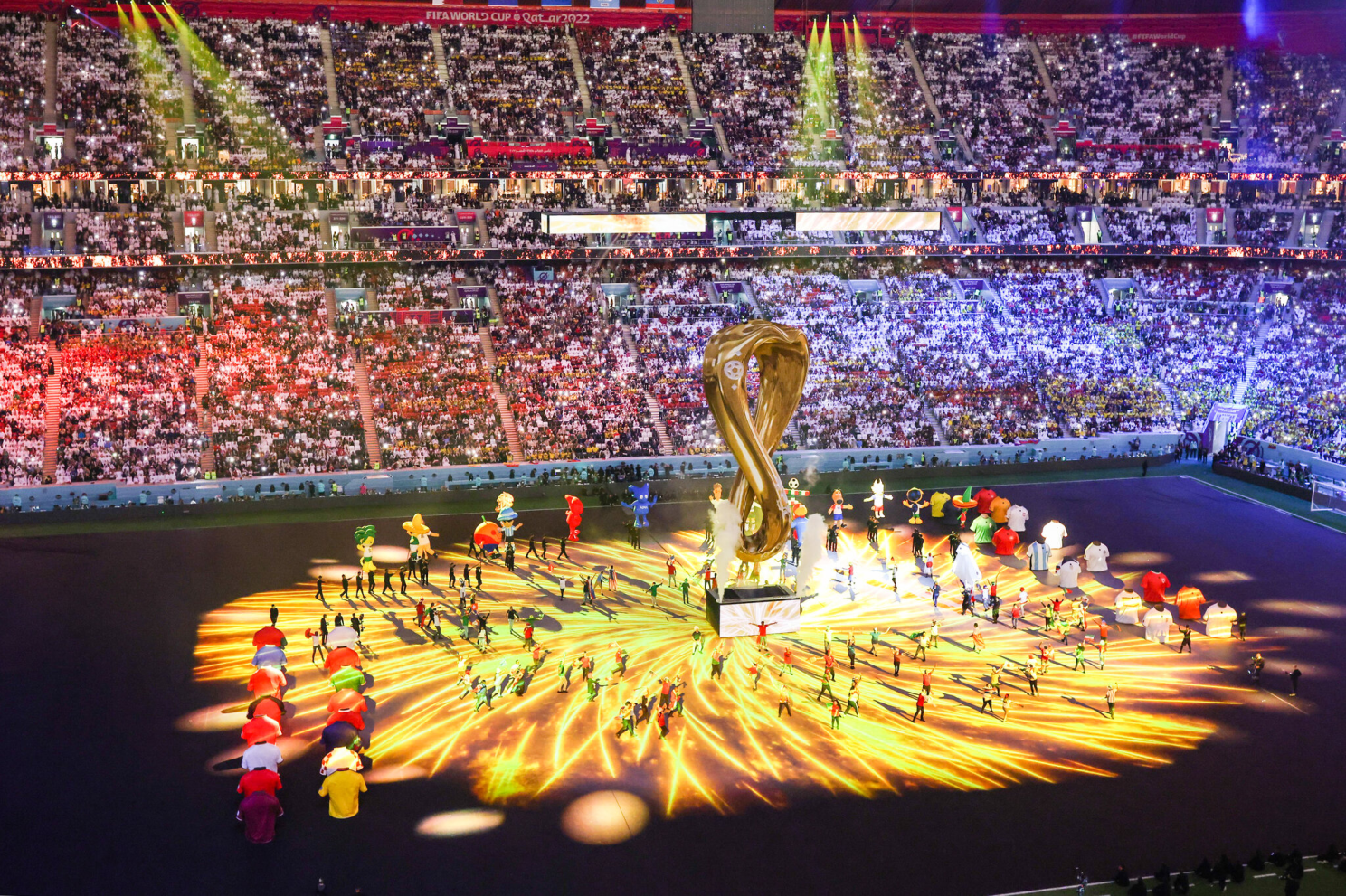
FIFA World Cup 2022 Qatar, Opening Ceremony. Credits: Tasneem Alsultan, The New York Times
Qatar's ambitions for hosting the World Cup were not to turn a profit, but it helped massively with its national development plan (National Vision 2030) - something we may see again with Saudi Arabia in 2034. A lot of the investment was on infrastructure such as metro lines, roadways and even a modern airport. The World Cup became a catalyst for achieving the National Vision. Finally, the economic diversification of Qatar's GDP was supported by increased tourism - putting the country on the global tourism map. This gave me a completely different view on the motivations of a country to host the World Cup. Qatar treated its $220+ billion 2022 World Cup budget (most expensive World Cup in history so far) not as a sports entertainment expense, but as an accelerated, front-loaded capital investment to buy decades of non-hydrocarbon GDP infrastructure. However, Qatar too ran into the same problems - large expensive stadiums sat unused, making the World Cup investments not as sustainable for the general public.
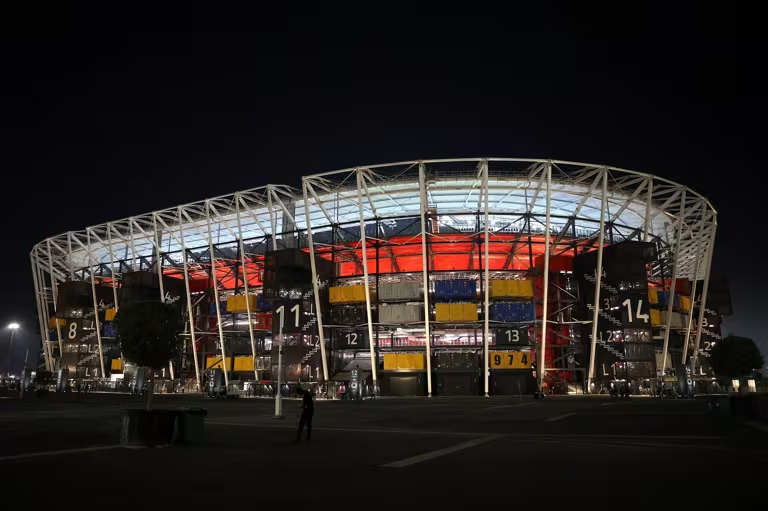
The only waterfront venue with a spectacular view of the Doha skyline, Stadium 974 was constructed using standard certified shipping containers and modular steel elements, echoing the nearby port and the industrial history of the plot - FIFA
One of the most talked about arenas at Qatar was the Stadium 974 - built acknowledging the mistakes of previous hosts and to avoid leaving behind a "white elephant" - this stadium was unique. It was built using exactly 974 (which is also Qatar's international dialing code!) recycled shipping containers and modular steel, it was the first fully demountable stadium in World Cup history. The entire structure was meant to be dismantled and either donated as smaller sports venues to countries in need or reassembled in another host city. Unlike Brazil, it had a plan. Four years on and the stadium still stands, has remained fully operational to host major tournaments. Plans and reality may not necessarily coincide.
This brings us (me) to today, World Cup 2026. The first World Cup with 3 hosts and with 48 teams, is the most complex sporting event in history and the North American bid was unique in both size and scope. Unlike Brazil or Qatar, North America already possessed most of the infrastructure and logistical know-how to put on the tournament. The "winner's curse" occurs when a host country overpays by building billions of dollars in specialized infrastructure (like stadiums and transit lines) that have no long-term economic use. In the case of the USA, they did not have to build any new stadiums, as existing stadiums which have been paid off by team owners were used. No "White Elephant" here. Mexico and Canada too just had to renovate a few stadiums which was a marginal cost and the logistics and security costs were split among the 3 countries, making the expenses easier to manage.
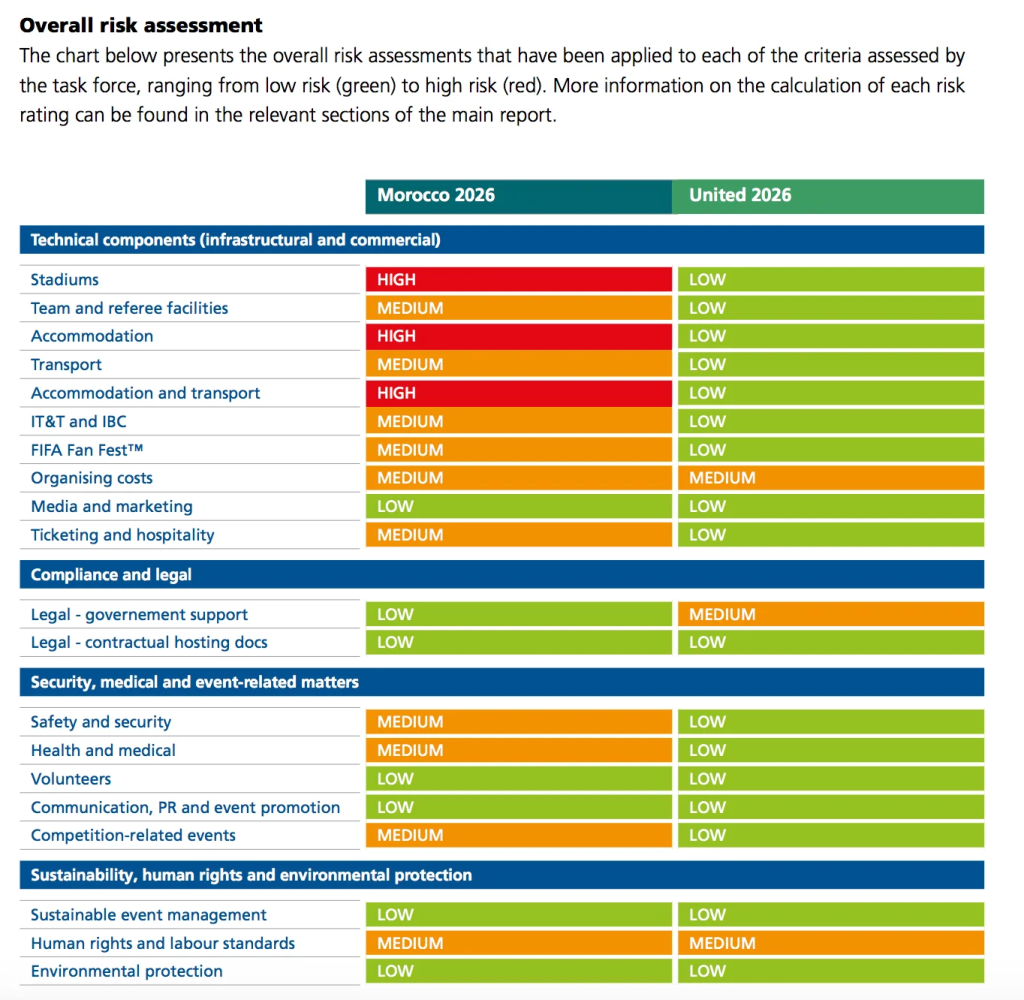
Source: FIFA 2026 World Cup bid evaluation report
As for answering the "why", each host enters with different incentives: the United States gains commercially without major infrastructure spending, Canada strengthens the long-term profile of football domestically, and Mexico benefits from tourism and international visibility while sharing the financial burden.
All of this is the visible surface. Underneath every World Cup runs a parallel economy. Every legitimate market created by the World Cup has an illegitimate counterpart. Tickets create scalping. Merchandise creates counterfeits. Broadcasting creates piracy. Betting creates opportunities for laundering. Together they form a temporary shadow economy that exists alongside the tournament itself. The past few years have taught me about this shadow economy, the predicate crimes that plague such an occasion and its impact.
The 2026 World Cup has not been without controversies, though many stem from the same source: tickets. Pricing, complaints, confusion and concerns have all had their limelight. FIFA did things differently this year - extremely high ticket prices, the infamous digital Right to Buy (RTB) Tokens or the Dynamic Pricing could be discussed but it's the attempt to fix ticket scalping that I found interesting.
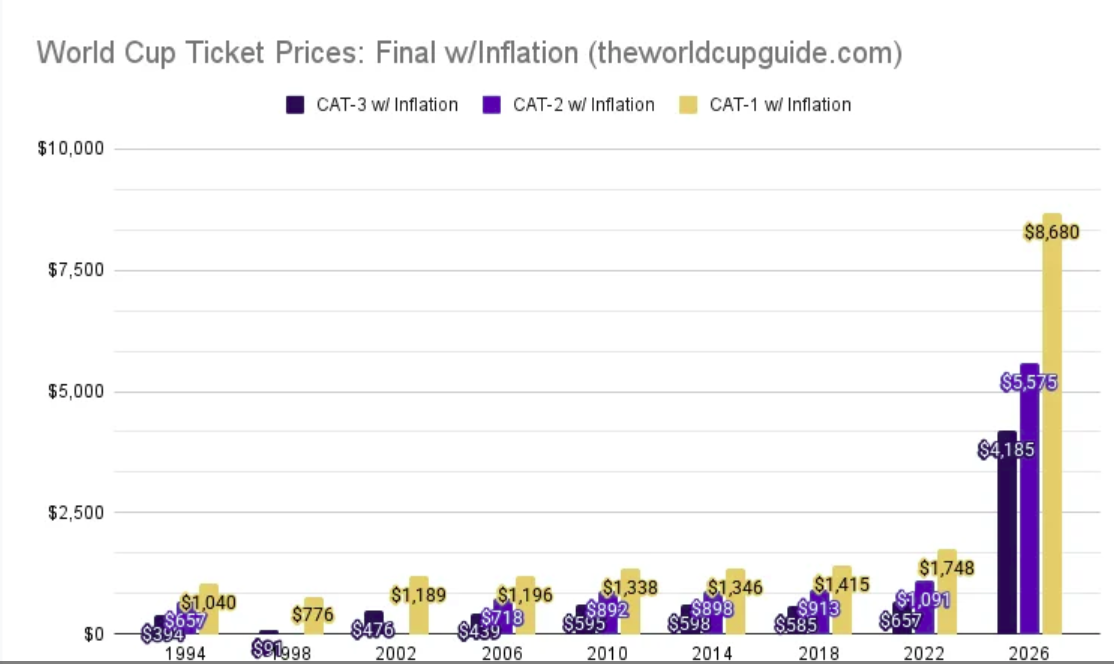
Comparing the prices of the WC Finals over the year, adjusted for inflation. Credit : theworldcupguide.com
Ticket scalping (purchase tickets cheap and sell expensive, like a short-term investment I suppose) has been a practice not exclusive to sport, and it's a problem as old as entertainment. FIFA figured that if they sold tickets at lower prices, scalpers would simply buy them and resell them at sky-high prices. Why lose the opportunity of earning in the secondary markets? Along with the eyewatering prices for tickets, FIFA introduced the Resale/Exchange Marketplace, where people could resell their tickets (at face value or less only in Ontario and Mexico due to local legislation, and no upper limit on sale otherwise) and FIFA would in turn charge 15% of the resale value from the seller and 15% from the buyer to facilitate this transfer. Did this end scalping? Some argue that FIFA has just institutionalized a form of "sanctioned scalping".
For some context - the FIFA Resale/Exchange marketplace isn't the only platform for resale of tickets, but it is the only official and guaranteed method. Unofficial platforms like StubHub have come under fire for Drip Pricing, last-minute cancellations and its overall higher risk factor.
Counterfeiting is another interesting by-product of this sporting festival. From June 1-5, officers seized 68 shipments of counterfeit FIFA World Cup 2026 merchandise. In total, officers intercepted 2,589 items that–if genuine–would have had a combined manufacturer’s suggested retail price of $266,566. Small value? Yes, until you realize that those are just the shipments that have been intercepted successfully. Fake goods can lead to real dangers. Unfortunately, the dangers of buying counterfeit products aren’t always obvious. Many counterfeit products are made with substandard materials or components and can be hazardous to your health. Potential exploitation of labor, resources and also the fact that these counterfeits could be the lifeblood for funding criminal enterprises make the act of purchasing a counterfeit look like a seemingly innocent activity, which could have dramatic consequences.
Another seemingly harmless component of the shadow economy is illegal streaming, but this is more sinister than it seems. It exposes users to severe cybersecurity and legal risks, deprives licensed broadcasters of revenue, and undermines the creative industries. The United States has seized hundreds of internet domains used to illegally stream the World Cup matches. In a completely counterintuitive manner, illegal streaming actually drives up the prices of legal licensing rather than making it cheaper, because media corporations raise prices to offset lost revenue. There's common wisdom in the market these days - "Nothing is free. If you are not paying for a product, you are the product". Credential stealing/hijacking tools are heavily deployed to access bank accounts and personal devices.
Some vulnerabilities are not just financial, but arise simply because millions of people move across borders simultaneously.
The FIFA referee Omar Artan from Somalia being denied entry, travel restrictions affecting certain national teams, and bans impacting citizens of participating nations all drew international attention. Large-scale events like the World Cup create significant border pressure. For a country like the United States, which has long grappled with irregular migration, a tournament of this scale amplifies existing vulnerabilities. Human rights organizations called for FIFA to intervene - a reasonable position, given that football genuinely is the world's sport. From an AML and compliance standpoint, mass human movement across borders also creates conditions for human trafficking and exploitation, which are designated predicate offences under most AML frameworks.
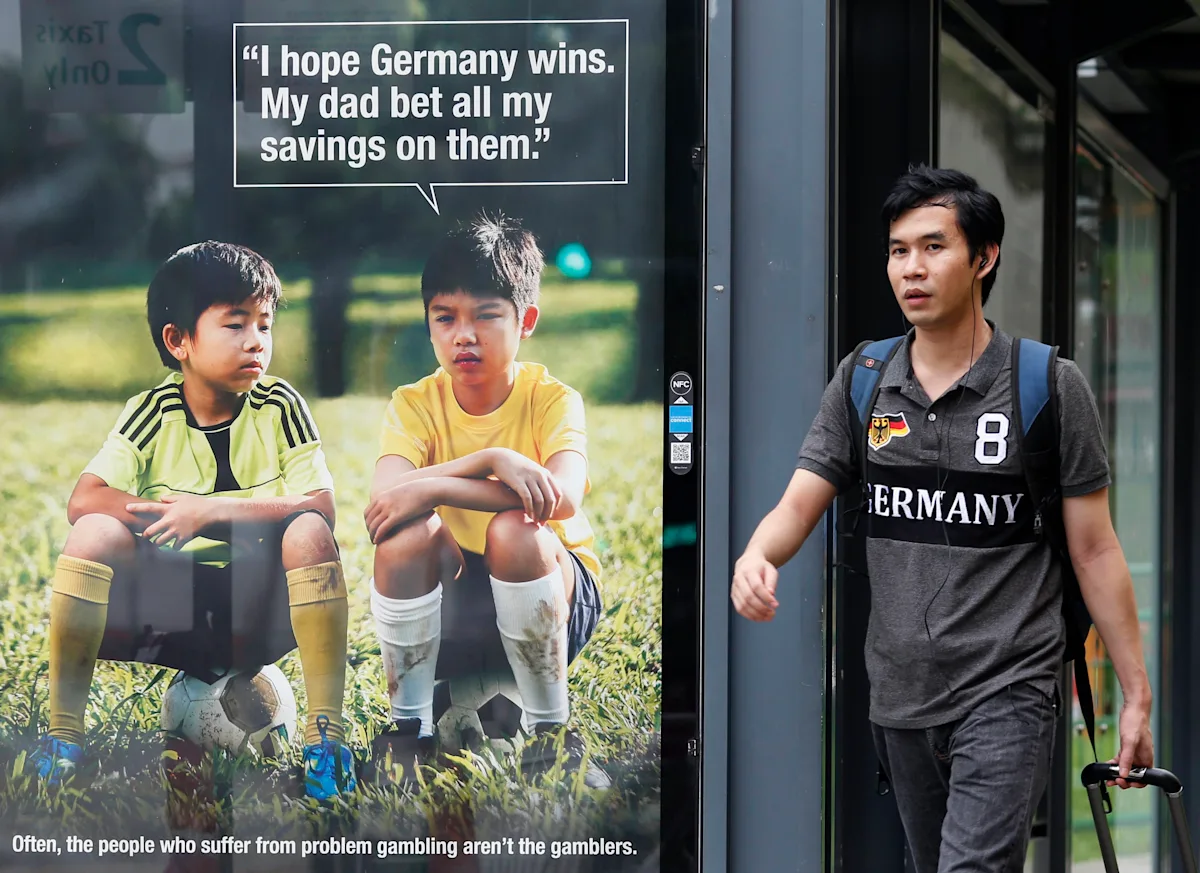
This 2014 Anti-Gambling Ad released in Singapore backfired when Germany were crowned World Champions in 2014.
Football betting has mushroomed since the 1990s, with the rise of the internet making live betting accessible worldwide. For context, gambling is heavily integrated into club football’s commercial operations, though this varies by jurisdiction. At the World Cup, FIFA actively monitors the global betting markets in real-time and scrutinizes on-field actions to detect any manipulation. The task force works across multiple jurisdictions with agencies to ensure tournament integrity. Unlike domestic club tournaments, FIFA enforces a strict ban on all gambling branding at World Cup venues.
According to the BBC, The World Cup is set to be the biggest betting event of all time, with more than $50bn (£37.4bn) in wagers placed globally. The sheer volume makes this tournament the ideal environment for layering, where illicit money is distanced from its criminal source (especially via crypto, e-wallets which are easily accessible now). This could also lead to big stakes where matches are "fixed", and may also give rise to insider betting. This overlap with human trafficking makes betting one of the most complex AML risk areas the tournament produces. The Global Initiative Against Transnational Organized Crime has also documented these trends in depth, specifically the heightened risks in global gambling systems tied to major sporting events.
I suppose these challenges have always existed, so what's special about the 2026 angle? Three jurisdictions with different AML frameworks (FinCEN in the US, FINTRAC in Canada, and Mexico's UIF) creates regulatory seams that bad actors can exploit. The three-jurisdiction structure of the 2026 World Cup is, in many ways, a microcosm of the broader challenge in AML compliance: the rules exist, but it's the gaps where the risk lives. FinCEN, FINTRAC, and Mexico's UIF each operate under different thresholds, reporting obligations, and enforcement priorities. A transaction that triggers a Suspicious Activity Report in the US may not meet the threshold in Canada, and vice versa. Bad actors understand geography better than most of us give them credit for. In fact, this was already outlined by the Financial Action Task Force (FATF) as far back as 2009 in the Money Laundering through the Football Sector publication. They identified football's cross-border money flows risk falling entirely outside national oversight, a finding that has only become more relevant with a three-jurisdiction World Cup in 2026. This publication also flagged "the illusion of innocence", where people are reluctant to report suspected wrongdoing in football because of the sport's social status. This suppresses STR filings even where suspicion exists. A deep dive into this is another full-fledged project, so we'll leave it at that.
What started for me as a college presentation about football economics has, over twelve years, evolved into something I find far more interesting: the idea that a football tournament is not just a sporting event, but a temporary financial ecosystem, complete with its own shadow economy, its own vulnerabilities, and its own cast of actors operating just outside the floodlights.
Every World Cup has changed the way I look at football. The 2026 edition may be the first that changes the way I look at financial crime.
The world is round, so is the ball. The money is rarely that simple.
Disclaimer: Content posted is for informational and knowledge sharing purposes only, and is not intended to be a substitute for professional advice related to tax, finance or accounting. The view/interpretation of the publisher is based on the available Law, guidelines and information. Each reader should take due professional care before you act after reading the contents of that article/post. No warranty whatsoever is made that any of the articles are accurate and is not intended to provide, and should not be relied on for tax or accounting advice.Contributor
Delwyn Mathews (CAMS)
Business Development Manager at IntelleWings | Anti-Money Laundering Specialist
Delwyn Mathews is an AML/CFT specialist with over 6 years of experience in business development, compliance solutions, and operations management across the UAE and India. Currently leading business development at IntelleWings, he helps organizations strengthen fraud detection, streamline KYC/CDD, and enhance regulatory compliance. A Certified Anti-Money Laundering Specialist (CAMS), Delwyn combines expertise in sales, project planning, and data analysis with a strong focus on financial crime prevention and compliance technology.
Related Posts

Introduction: A Defining Shift in AML Compliance In 2026, the United Arab Emirates has introduc...
Read More
A Growing Focus for DNFBPs Designated Non-Financial Businesses and Professions (DNFBPs) pl...
Read More
Compliance Does Not End at OnboardingIn many compliance frameworks, onboarding has traditionally bee...
Read More