
Value Added Tax (VAT) in the UAE can feel confusing, especially when it comes to schools and universities. Some things are taxed, some are not, and some depend on small details. This article breaks it all down in plain, everyday language so you know exactly what is taxed and what isn't.
The Basic Idea: Two Boxes to Tick
Not every school or course automatically gets a VAT break. For education services to be "zero-rated" (meaning 0% VAT instead of the usual 5%), two things must both be true at the same time:
• The institution is a "Qualifying
Educational Institution" recognised by a government authority, or (for
higher education) either government-owned or getting more than 50% of its
yearly funding from the government.
• The course follows a "Qualifying
Curriculum" one that is officially recognised by the government body in
charge of education in that area.
If either box is not ticked, the service is taxed at the standard 5% rate. This 0% rule is treated as an exception, so it's applied strictly both conditions must be clearly proven, often with documents like a licence or funding records.
What Actually Counts as "Education"?
The law does not spell out an exact definition of "education." It's simply understood in the normal sense: teaching, training and learning that happens in places like schools, colleges and universities, aimed at building knowledge and skills.
Gets 0% VAT (Zero-Rated)
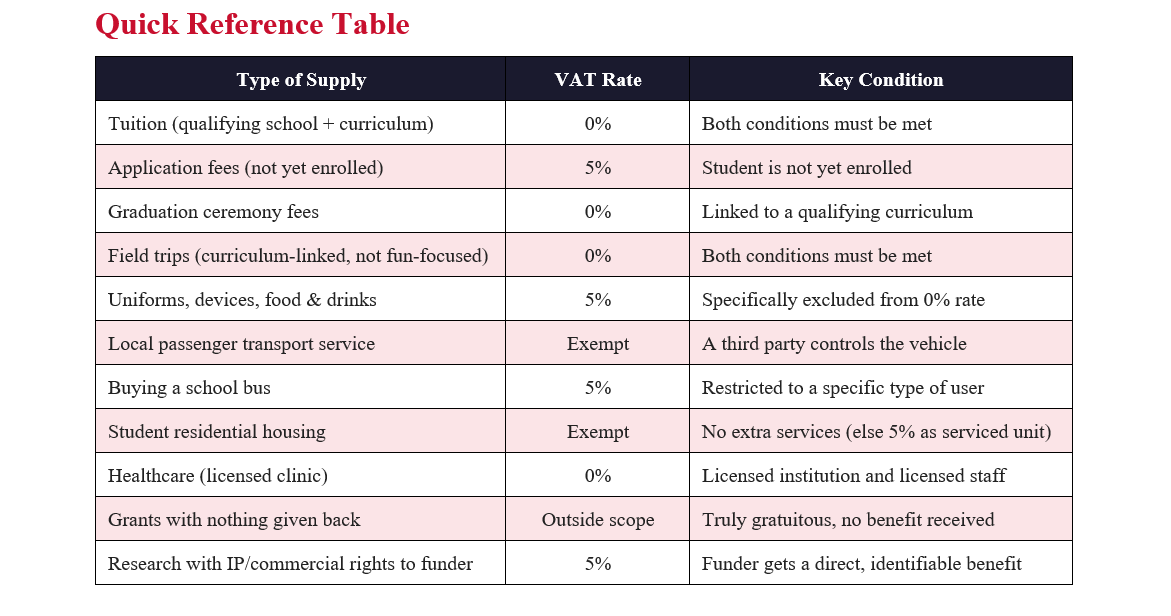
Tuition delivered by a qualifying school or university, teaching a curriculum that is officially approved. Both conditions from the section above must be met together.
Gets 5% VAT (Standard-Rated)
• Private tutoring or home-schooling
given by people or businesses that are not qualifying institutions
• Diplomas or courses that don't lead
to a recognised degree
• Skills training at private training
centres
• Education management services
provided by outside companies
What About Books, Trips and Extra Activities?
Goods and services sold by a qualifying school can also be tax-free, but only if they are a necessary and integral part of delivering the education, not just something extra sold on the side.
Usually Tax-Free (0%)
• Printed
or digital textbooks tied to the approved curriculum
• School
trips that are clearly linked to what's being taught, and not mainly for fun
• Extra
activities like football training, as long as there's no extra charge for them
• Re-registration
fees for students already enrolled
• Special
needs support that is part of the curriculum
Usually Taxed at 5%
• Items
sold to people who aren't enrolled students
• School
uniforms and required clothing
• Devices
like tablets or laptops
• Food
and drinks, including vending machines
• Extra
activities that cost extra money
• Trips
that are mostly for fun, like a waterpark or amusement park
Common Situations Explained Simply
Application and Registration Fees
If a student hasn't been
accepted yet, the application fee is taxed at 5%. But if they get in and the
fee is later counted toward their tuition, the school should cancel the
original tax invoice (with a credit note) and issue a new zero-rated invoice.
School Fundraisers
A cake sale to raise
money for a new library is normally taxed at 5%, because it's a fundraising
activity, not teaching. But if it's something like a concert that is actually
part of a student's official exam, it can be tax-free.
Field Trips
A trip only avoids tax if
it is closely tied to the curriculum and not mostly for entertainment. A
waterpark trip is taxed. A museum visit connected to an art class is not.
Graduation Ceremonies
Fees for graduation and
certificates linked to an approved curriculum are tax-free. Basic refreshments
served at the event don't change this.
Beyond the Classroom: Housing, Buses and Health
Student Housing
Renting out a residential
building is generally exempt from VAT. But if the school also throws in
services like room cleaning, laundry, or meals, it becomes a "serviced
unit" and is taxed at 5% instead. Shared spaces like lounges and general
cleaning don't count as extra services.
School Buses
Paying for a transport service where someone else drives and owns the bus is exempt from VAT. But if the school buys or leases its own bus, that purchase is taxed at 5%, because school transport isn't treated as general public transport.
Health Clinics
A clinic run by a
licensed school with licensed doctors or nurses can be tax-free. But admin
charges, like opening a medical file or an annual health fee, are taxed at 5%.
If an outside healthcare company supplies services to the school (rather than
directly to students), that's taxed too.
Online and Distance Learning
Pre-recorded courses that
run automatically, with no live interaction, count as "Electronic
Services." But if students can actually talk to a tutor or get personal
help, it's not treated as an Electronic Service. This distinction matters a lot
for foreign providers, since it can affect whether they need to register for
UAE VAT.
Money Coming In: Grants, Scholarships and Research
The key question here is simple: does the person paying get something valuable back in return?
• Third-party tuition (parent, employer
or government pays): treated the same as if the student paid tax-free if the usual conditions are met.
• Scholarships from the school: treated
like a discount, so VAT is charged only on the smaller, discounted amount.
• Pure grants or donations with nothing
given back: outside the scope of VAT entirely.
• Grants where the donor gets
something, like naming rights: this counts as payment for a service, so VAT
applies.
• Research done for commercial reasons,
or where the funder gets shared rights to the results: taxed at 5%. Renting out
labs or facilities to outsiders is taxed too.
Claiming Back VAT on Purchases (Input Tax)
Schools can only claim
back the VAT they paid on things they bought if those purchases were used to
make taxable (5%) sales. VAT spent on exempt activities, like plain residential
accommodation, can't be claimed back.
If a school has a mix of taxable and exempt income, it needs to work out a fair split (apportionment) for shared costs. There's also a special "Capital Assets Scheme" for big-ticket items, buildings or other assets worth AED 5,000,000 or more, used for 10+ years (buildings) or 5+ years (other assets).
• Events like National Day celebrations
or recruitment days: VAT is claimable as a normal business cost. But VAT on
pure entertainment, like an iftar dinner, cannot be claimed.
• Buying or renting a school bus: VAT
is charged at 5% on this. If that bus is then used to provide exempt local
transport, the VAT paid can't be claimed back.
• Staff accommodation: VAT can be
claimed only if it's legally required under UAE labour law, written into an
employment policy, or genuinely necessary for the employee's job ideally all
three.
The Bottom Line
VAT on education in the
UAE comes down to two simple checks: is the institution officially qualifying,
and is the curriculum officially recognised? Once you know that, most other
questions about trips, fees, buses, housing
or research fall into place using the same logic: is it genuinely part of
delivering education, or is it something else attached to it?
Because the rules have many small exceptions, it's worth getting professional advice for anything unusual or high-value.
Disclaimer: Content posted is for informational and knowledge sharing purposes only, and is not intended to be a substitute for professional advice related to tax, finance or accounting. The view/interpretation of the publisher is based on the available Law, guidelines and information. Each reader should take due professional care before you act after reading the contents of that article/post. No warranty whatsoever is made that any of the articles are accurate and is not intended to provide, and should not be relied on for tax or accounting advice.Contributor
Zubair Khan – Corporate Trainer & Finance Expert
Based in Dubai, UAE, Zubair Khan is a Chartered Accountant (CA) and Partner – Taxation at RHMC with 14+ years of experience delivering corporate training for mid to top management, finance professionals, and business leaders. He specializes in IFRS, UAE Corporate Tax, VAT, financial statement analysis, and finance for non-finance professionals.
He has trained professionals across industries, including Louis Vuitton, Imdaad, Strata Manufacturing, JCDecaux, and more. Zubair combines technical expertise with practical, real-world applications to enhance strategic decision-making and regulatory compliance.
Qualifications: CA (ICAI), Diploma in IFRS (ACCA), B.Com
Previous Roles: Corporate IFRS Coach, Educator at Unacademy, BB Virtuals, Lakshya CA Campus.
Related Posts

The question everyone asks A UAE company is building a plant. To fund it, treasury borrows in a ...
Read More
A VAT-registered business charges VAT on its sales (Output VAT) and pays VAT on its purchases (Inpu...
Read More
If your business buys and resells used goods, antiques, or collector's items, there is a special VA...
Read More