

Key points:
• It applies to certain payments made from Saudi Arabia to non-residents.• The date of payment determines the withholding tax treatment.
• For regional headquarters in Saudi Arabia, certain payments to non-resident entities may be subject to 0% withholding tax for 30 years, subject to conditions
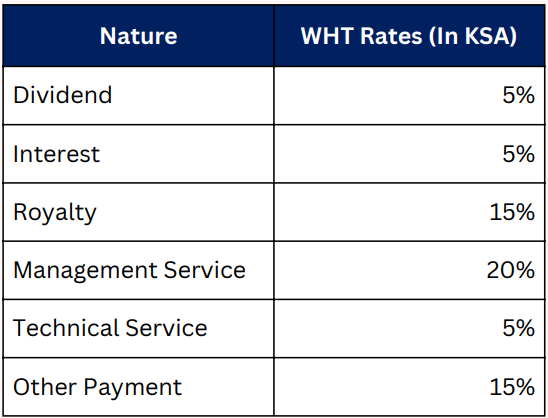
The rates for witholding taxes are given below:
Kuwait - Saudi Tax Treaty
Agreement between the government of the Kingdom of Saudi Arabia and the government of the State of Kuwait for the avoidance of double taxation with respect to taxes on income and the prevention of tax evasion and avoidance, entered into force on August 01, 2025 took effect on January 01, 2026.Under the Double Taxation Avoidance Agreement (DTAA) the most critical point to monitor is whether the activities create a "Permanent Establishment" (PE) in KSA. Under the agreement, KSA generally cannot tax the business profits of a Kuwaiti company unless that company operates through a PE located within KSA.
Permanent Establishment
A business must determine if it has a fixed place of business in KSA. Common examples include:• Physical Presence: Having a branch, office, factory, workshop, or any place for extracting natural resources.
• Construction Projects: Building sites or assembly projects that last for more than 183 days.
• Service Provision: Providing services (including consultancy) through employees if those activities continue for more than 183 days within any 12-month period.
• Natural Resources: Activities related to exploring or exploiting natural resources that last for more than 30 days in a 12-month period
Role of Agents
A business can be deemed to have a PE in KSA even without a physical office if it uses a "dependent agent". This applies if a person in KSA habitually concludes contracts on behalf of the Kuwaiti business or plays the primary role in leading to the conclusion of such contracts.Taxes on Specific Income Types mentioned in DTAA
Even if there is no PE, certain payments from KSA to a Kuwaiti business are subject to specific tax rates or "caps" under the agreement:• Dividends: Generally capped at 5% of the total amount.
• Royalties: Capped at 10%.
• Technical Services: Fees for administrative, technical, or consultancy services are capped at 10%.
• Immovable Property: Income from real estate located in KSA (like rent) can be taxed by KSA according to its own laws
Avoiding Double Taxation
The primary benefit for a Kuwaiti business is the ability to avoid paying tax twice on the same income. If KSA taxes the income of a Kuwaiti resident in accordance with the agreement, the business can generally claim a deduction or credit in Kuwait for the tax paid in KSA, provided it does not exceed the tax amount due in Kuwait on that same income.Domestic Law vs. Treaty Benefits
• If Domestic Law is Lower (5%): If Saudi Arabia's domestic law already sets the withholding tax at 5% for a specific technical service, that 5% rate is what applies. Since 5% is already below the 10% limit set by the treaty, the tax is already in compliance with the agreement.• If Domestic Law is Higher: If KSA were to increase its domestic rate for technical services to 15% in the future, a Kuwaiti business would then invoke the DTAA to "cap" that tax at 10%.
Double Taxation Treaty (DTT)
To claim Relief at Source/ Refund approach for the WHT taxes deducted by the KSA Company, ZATCA (Zakat tax and Customs authority) has introduced new form through ERAD (Saudi tax administration-Electronic filing system).Sections in the New DTT Application form are :
1.Information about Claimant (NonResident) (Kuwaiti Company who does not have a PE in KSA)
2.Beneficial Ownership Confirmation
3.Declaration made by the claimant
4.Certification by tax authority of Claimant (Tax Residency Certificate acts as a substitute for this section)
5.Income Claimed for Tax Treaty Relief at source
6.Income Claimed for Tax refund
7.Declaration of the resident (KSA Co)
The above DTT Application form along with Tax Residency certificate needs to be submitted to the customer for the relief at source and for refund approach additional documents needs to be submitted.
Important Note: Once the Application is submitted along with the documents, It needs to be attached in WHT form.
Disclaimer: This article is intended for general informational purposes only and reflects the withholding tax rules and treaty provisions as understood at the time of writing. It does not constitute legal, tax, or professional advice and should not be relied upon as such. Tax treatments can vary based on specific facts and circumstances, and provisions may be subject to further clarification or amendment by the relevant authorities. Readers and businesses are strongly advised to seek independent professional consultation before applying any of the above to a client's specific situation or making decisions based on this content.
Contributor
CA Devang Mehta, CPA (Ireland) is a Tax and Compliance professional with over 10 years of experience advising businesses across the GCC, with a particular focus on the Kingdom of Saudi Arabia and the UAE. He currently serves as Compliance Manager at a consulting firm in UAE, where he advises multinational companies and regional businesses on Corporate Tax, VAT, Withholding Tax, Zakat, and regulatory compliance.
Devang has extensive experience assisting foreign investors with Company Formation, Regional Headquarters (RHQ) formation in Saudi Arabia, including entity structuring, MISA licensing, tax registrations, ongoing compliance, and governance requirements. He regularly advises clients on KSA Corporate Tax, VAT, transfer pricing, and regulatory obligations to help businesses establish and operate efficiently in the Kingdom.
A Chartered Accountant from India and Certified Public Accountant (CPA) from Ireland, Devang has also worked with KPMG India in Risk Advisory and has led numerous cross-border tax and compliance engagements across the GCC
Related Posts

IntroductionUnderstanding the Date of Supply, Place of Supply, and Transitional Rules is fundamental...
Read More
The question everyone asks A UAE company is building a plant. To fund it, treasury borrows in a ...
Read More
A Welcome Relief from the Federal Tax AuthorityThe Federal Tax Authority's decision to extend the SB...
Read More