
Strong controls exist across the diamond trade. The real compliance question is whether every participant and transaction remains within them.
The diamond trade operates through multiple layers of regulation, certification, customer due diligence, sanctions screening and commercial traceability. Across the principal mining, trading, cutting, polishing and retail centres, these controls have become increasingly sophisticated.
Recent enforcement cases and regulatory assessments, however, demonstrate an important distinction: the existence of a strong control framework does not necessarily mean that every participant operating under the broader label of the diamond or jewellery trade is equally well controlled.
That distinction matters.
A meaningful discussion of money laundering risk in the diamond sector should therefore neither portray the industry as inherently opaque nor assume that certification by itself eliminates financial crime risk. The better question is where the recognised controls apply effectively and where activity can migrate beyond their practical reach.
The Global Baseline
At the international level, the diamond industry benefits from a control mechanism that few other high value commodities possess.
1. The Kimberley Process Certification Scheme establishes a framework for the international movement of rough diamonds and is intended to prevent conflict diamonds from entering the legitimate supply chain. Participating jurisdictions are expected to permit international trade in rough diamonds only through the prescribed certification framework. This provides an important first layer of provenance and legitimacy.
2. Alongside it sits the international anti money laundering framework. FATF standards classify dealers in precious metals and precious stones as Designated Non Financial Businesses and Professions, requiring customer due diligence and related AML controls in circumstances prescribed by the standards and domestic implementing laws.
International financial intelligence research has also examined vulnerabilities throughout the diamond value chain, from mining and the initial sale of rough stones through trading, cutting and polishing, jewellery manufacturing and eventual retail.
The commercial sector has developed another layer beyond regulation. Large manufacturers, established traders and international luxury businesses increasingly require documented provenance, supplier verification and chain of custody information. In more sophisticated supply chains, it may be possible to establish where a stone originated, how it moved through the trading process, where it was polished and to whom it was subsequently supplied.
The result is a comparatively strong control environment comprising:
- Certification at the rough diamond stage
- AML supervision of market participants
- Progressively stronger commercial traceability throughout the downstream supply chain
But these controls address different risks. They should not be treated as interchangeable.
Traceability Is Not the Same as AML Compliance
This is perhaps the most important distinction.
A diamond may be fully traceable from an authorised source and still become part of a transaction presenting money laundering concerns.
Conversely, a suspicious financial transaction involving a jewellery business does not necessarily establish that the underlying diamond entered the supply chain illegitimately.
Traceability primarily addresses questions such as:
- Where did the stone originate?
- Did it enter the legitimate rough diamond supply chain?
- Through whom did it subsequently pass?
AML controls ask a broader set of questions:
- Who owns or controls the customer?
- What is the customer's source of funds or source of wealth?
- Does the transaction make commercial sense?
- Is the payment coming from the expected party and jurisdiction?
- Is an intermediary being used without an apparent economic reason?
- Is the business properly licensed and registered?
- Are sanctions and other financial crime controls being applied?
- Does the movement of money correspond with the movement and value of the goods?
A strong answer to the first group of questions does not automatically answer the second. That is why the industry can simultaneously have excellent product traceability and residual financial crime exposure.
The Large Processing and Manufacturing Centres
One of the distinctive characteristics of the diamond industry is its concentration.
1. A significant proportion of the world's rough diamonds passes through a relatively small number of specialist centres for cutting, polishing, grading, financing and onward distribution.
2. These centres generally operate within detailed domestic AML frameworks. Dealers above prescribed thresholds may be required to register with financial intelligence authorities, maintain customer identification records, establish beneficial ownership, monitor transactions and report suspicious activity.
The challenge identified in regulatory assessments is therefore often not the absence of legislation.
It is supervisory reach.
A major processing centre can include thousands, or even tens of thousands, of businesses ranging from large exporters and internationally recognised manufacturers to small workshops, independent traders and jewellery dealers.
Trade associations may closely supervise and influence their members, while the broader commercial population can be considerably larger.
This creates an important compliance distinction between:
(1) Businesses operating within organised, regulated and internationally connected supply chains
and
(2) Smaller or less formal businesses operating at the edges of those networks.
A gap between the total number of market participants and the population receiving intensive industry or regulatory oversight should not be interpreted as evidence that the entire sector is compromised.
It is instead evidence of a familiar AML challenge: how to achieve consistent supervision across a large, fragmented and commercially diverse population.
International Trading Hubs
The same distinction appears in major international diamond trading centres.
Formal wholesale markets can operate with extensive controls around membership, import and export documentation, certified rough diamonds, banking relationships, customs declarations and counterparty due diligence.
Yet immediately outside that institutional infrastructure may sit a much broader secondary market involving jewellery, watches, recycled precious metals, second hand goods and cash intensive retail activity.
Recent investigations in established trading centres have highlighted alleged criminal activity within parts of these peripheral markets.
That does not necessarily indicate a failure of the certified rough diamond system.
It may instead demonstrate that financial crime risk migrates towards areas where ownership, provenance, payment and customer controls are weaker.
Consider the difference between:
A rough diamond moving through an authorised importer, certified trading platform, established manufacturer, regulated bank and international retailer
and
A polished stone or piece of jewellery changing hands through an informal intermediary, secondary dealer, unrelated third party payer or unregistered financial channel.
Both transactions involve diamonds.
Their AML risk profiles are completely different.
This is why sector level generalisations can be misleading.
The relevant compliance unit is ultimately not the diamond industry.
It is the specific customer, counterparty, transaction and payment chain.
Regulation Works in Layers
The strongest compliance approach therefore treats controls as cumulative rather than substitutive.
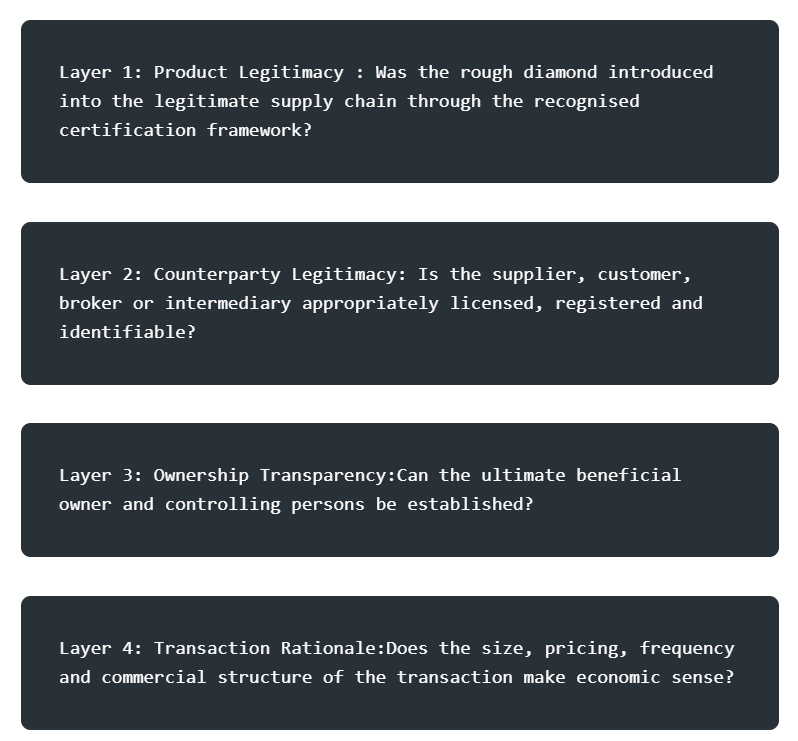
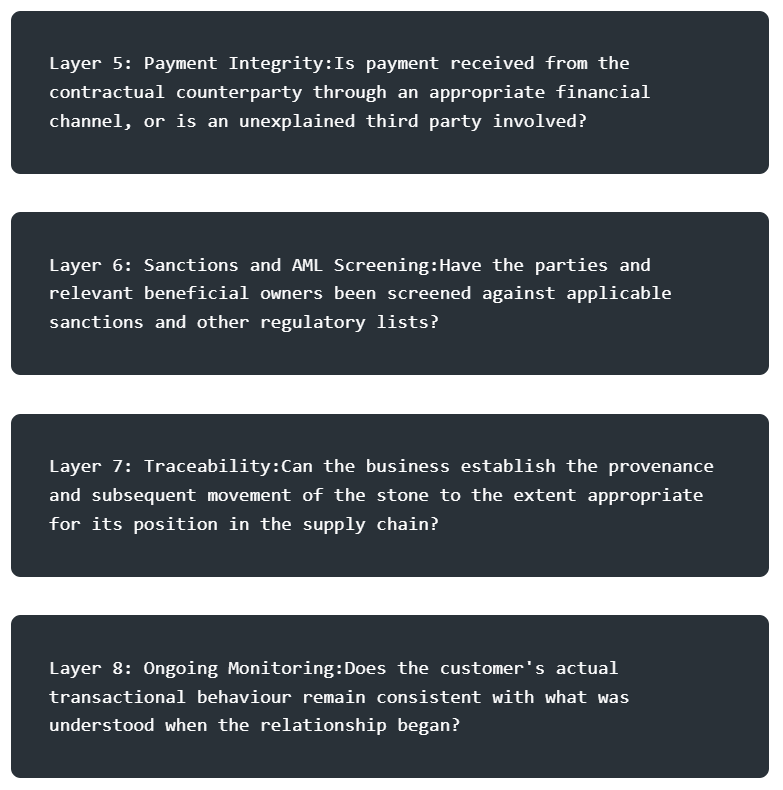
No single layer answers every question.
The strength comes from their combination.
What This Adds Up To
The diamond industry should not be described as a trade operating without controls.
Quite the opposite. It combines an international certification mechanism, jurisdiction level AML obligations, customs supervision, financial sector controls and increasingly sophisticated private sector traceability systems.
That places the legitimate organised diamond trade within one of the more structured control environments among high value goods.
But no regulatory architecture eliminates risk completely.
Recent cases and supervisory findings demonstrate narrower vulnerabilities:
- Fragmented dealer populations that are harder to supervise consistently
- Informal secondary markets operating beside highly regulated trading centres
- Businesses conducting activities for which they have not registered
- Third party payment arrangements
- Customs or invoicing manipulation
- Weak beneficial ownership transparency
- Transactions that move outside established banking and commercial channels
These are not arguments that the diamond industry's control system does not work. They are reminders of where its perimeter lies.
The Actual The Actual Question Worth Asking
Can diamonds be used for money laundering?
Almost any sufficiently valuable and transferable asset can be misused.
Does the diamond industry have traceability and AML controls?
It demonstrably does.
Does this particular transaction genuinely sit inside those controls?
And, fundamentally: Is the transaction occurring inside the regulated, traceable and financially transparent diamond ecosystem, or merely using the name of that industry while operating outside its safeguards?
Can diamonds be used for money laundering?
Almost any sufficiently valuable and transferable asset can be misused.
Does the diamond industry have traceability and AML controls?
It demonstrably does.
Does this particular transaction genuinely sit inside those controls?
And, fundamentally: Is the transaction occurring inside the regulated, traceable and financially transparent diamond ecosystem, or merely using the name of that industry while operating outside its safeguards?
That is where risk based AML analysis becomes useful.
Because the real dividing line is not between diamonds and other commodities.
It is between commerce conducted inside a functioning control framework and commerce deliberately, negligently or structurally conducted around it.
Disclaimer: Content posted is for informational and knowledge sharing purposes only, and is not intended to be a substitute for professional advice related to tax, finance or accounting. The view/interpretation of the publisher is based on the available Law, guidelines and information. Each reader should take due professional care before you act after reading the contents of that article/post. No warranty whatsoever is made that any of the articles are accurate and is not intended to provide, and should not be relied on for tax or accounting advice.Contributor
Related Posts

A registered company has a legal identity.It may have incorporation documents, a bank account, a web...
Read More
A contribution form records who is giving the money.But what if the person named on the form is not ...
Read More
An unusual payment can raise an important AML question.But the payment itself does not always explai...
Read More