

A year ago, "agentic AI" CA software that does not just answer questions but takes actions and completes multi-step workflows CA was a buzzword. In 2026 it is a budget line.
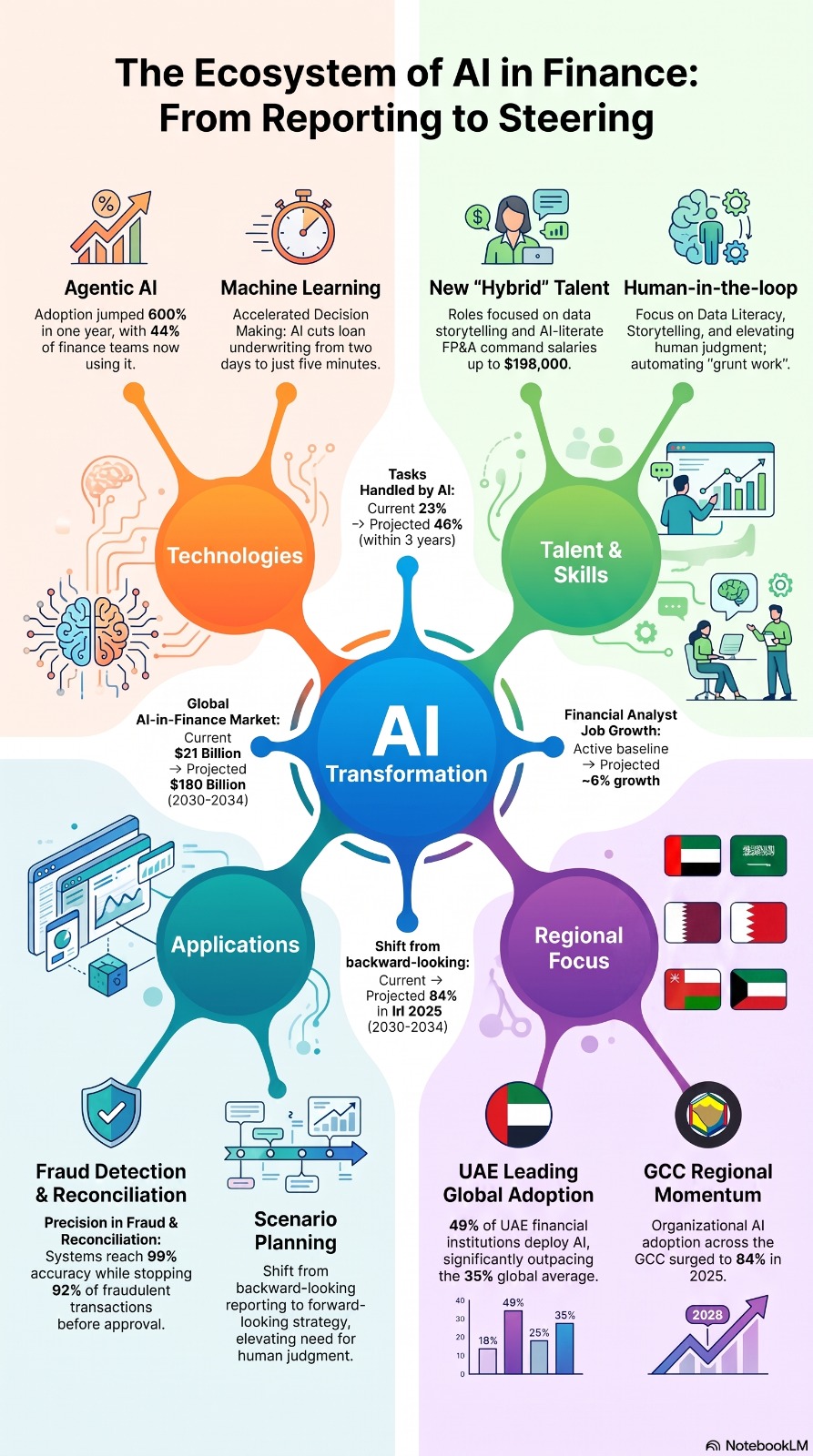
A Wolters Kluwer survey of finance leaders found that while only 6% were using agentic AI at the time of the survey, a further 38% intended to adopt it within twelve months CA putting projected usage at 44% of finance teams in 2026, an increase of more than 600% in a single year [1]. Citizens' research similarly found that 82% of midsize companies and 95% of private-equity firms have begun or plan to implement agentic AI in 2026, and that among adopters, a reported 99% cite improved efficiency and productivity [2]. A Cambridge Centre for Alternative Finance study found that roughly half of the financial services industry already has AI in active use, with a meaningful share at the more mature "scaling" or "transforming" stages [3].
The money follows the momentum. The global AI-in-finance market is projected by Markets and Markets at around USD 21 billion in 2026, growing toward USD 190 billion by 2030 at a compound annual rate of approximately 30% [4]. Financial services already leads other industries in AI adoption, accounting for close to a fifth of global AI spending, and institutions are reported to have spent more than USD 20 billion on AI in 2025 alone. KPMG's global research found that over three-quarters of finance organisations now use AI in planning, reporting, and commercial analysis, with 71% saying it is meeting or exceeding their ROI expectations [5].
The practical experience behind those numbers is simple: tasks that took two hours now take ten minutes, and tasks that took ten minutes now take thirty seconds. When that compounds across a whole team, it stops being a productivity tweak and becomes a change in operating model.
Where AI actually earns its place in finance
Not every AI claim survives contact with reality. But several use cases have moved firmly out of the hype column, and the performance data explains why finance leaders keep funding them.
Fraud detection CA the clearest ROI in finance. AI systems are reported to reach 90–99% detection accuracy while cutting false positives by as much as 60–80% versus traditional rule-based systems, and teams using AI report meaningful reductions in fraud losses. Juniper Research projects AI will save the industry over USD 10 billion in fraud-related costs by 2027 [6], and JPMorgan has publicly credited AI with savings reported at around USD 1.5 billion [7]. Real-time interception matters here: the shift is from flagging suspicious transactions hours later to stopping the large majority of them before approval.
Closing and reconciliation. AI categorises transactions, matches invoices to purchase orders, and reconciles accounts continuously rather than at month-end. "Touchless" invoice processing is becoming the norm, and documented anti-money-laundering deployments have reported significant reductions in suspicious-activity-report backlogs. The human role shifts to managing the exceptions the machine cannot resolve.
Forecasting and scenario planning. This is where value is most visible. Machine-learning models spot seasonal swings, leading indicators, and non-linear cost-to-outcome relationships that are hard to see by hand. An FP&A team can now run thousands of "what-if" scenarios in seconds instead of rebuilding a spreadsheet. Underwriting and lending show the speed gains vividly: loan decisions that once took days are reported to now take minutes at institutions with mature AI deployments.
Reporting and commentary. AI pulls data from finance systems, calculates standard measures, drafts variance commentary, and formats output CA compressing the reporting cycle and freeing people for interpretation. In customer-facing finance, AI assistants are reported to handle the majority of Tier-1 queries at major institutions, reducing service costs while lifting satisfaction.
The common thread: AI is best at the high-volume, pattern-heavy, first-draft work CA and it hands the judgment back to a human at the end.
A note for the UAE and the wider Gulf
For members practising in the UAE, this transformation is arriving faster than the global average CA which makes standing still more costly.
McKinsey research indicates that organisational AI adoption across the GCC rose from 62% in 2023 to 84% in 2025 [8]. KPMG's UAE finance benchmarking study found that 49% of UAE organisations report active AI usage or plans in their finance functions, against a 35% global comparison CA a lead of roughly 14 percentage points [9]. In IBM's EMEA research, 77% of UAE leaders reported significant productivity gains from AI (against a 66% EMEA average), and 92% expect agentic AI to deliver measurable ROI within two years [10]. Gartner forecasts MENA technology spending to reach USD 169 billion in 2026 [11].
One honest caveat belongs alongside these figures: the same KPMG study found that only 37% of UAE finance leaders report positive ROI from AI so far, compared with 66% globally [9]. Adoption in the region is ahead of the world; realised returns are still catching up. That gap is precisely why disciplined implementation and governance CA not enthusiasm CA will separate the leaders from the laggards.
The regional momentum is backed by national policy: the UAE's National AI Strategy 2031, its appointment of the world's first Minister of State for Artificial Intelligence in 2017, and DIFC-led AI governance work. The takeaway for a finance professional here is that the regional environment rewards early, well-governed adoption CA and the peer benchmark is already high.
The role changes CA from producing numbers to explaining them
The most common fear about AI in finance is job loss. The more accurate picture is job reshaping.
The direction is consistent across the profession: AI absorbs routine processing while raising the bar on everything else. A global MIT Sloan study found employees believe AI already performs 23% more of their tasks than a year ago, and expect it to handle 46% within three years [12]. Manual data entry, transaction processing, and basic reporting automate first CA and that is exactly the work on which junior professionals once learned the trade. Bloomberg Intelligence has projected that Wall Street banks could cut a substantial number of roles CA figures of up to 200,000 have been reported CA to automation over the coming years, with entry-level analysts among the most exposed [13].
But demand for judgment is holding up. The US Bureau of Labor Statistics projects financial-analyst employment to grow 6% from 2024 to 2034, faster than the average for all occupations [14], and new hybrid roles CA AI-literate FP&A managers, AI governance and compliance managers CA are reported to command six-figure salary premiums. The message is clear: the new work is less about producing the numbers and more about explaining them. Interpreting variances, pressure-testing an AI-generated forecast, challenging assumptions a model cannot see, and translating system output into business meaning for decision-makers CA this is becoming the core of the job.
The skills that rise in value are less technical than people assume: data literacy, the ability to prompt AI well and critically assess its output, and above all the ability to tell a clear story with the numbers. AI removes the excuse that you were too busy assembling data to think about what it means.
What this means for the chartered accountancy profession specifically
For members in audit and assurance, the implications cut both ways. AI is transforming audit fieldwork CA full-population testing instead of sampling, anomaly detection across entire ledgers, and automated vouching CA while simultaneously creating new subject matter to audit: management's own AI-generated estimates, model-driven provisions, and automated controls. Auditing standards on the use of technology, professional scepticism over machine-generated evidence, and documentation of how AI tools were used in forming an opinion are becoming live practice issues rather than academic ones.
Three principles are emerging for professional practice. First, responsibility is non-delegable: an AI tool may draft the workpaper, but the member signs the opinion, and professional standards and ethics codes make no exception for algorithmic error. Second, competence now includes AI literacy CA a member relying on a tool they cannot critically evaluate is in a weaker position than one who declined to use it at all. Third, documentation matters more, not less: regulators and quality reviewers will increasingly ask not just what conclusion was reached, but what role AI played in reaching it.
The risks are governance problems, not technology problems
The honest version of this story includes real hazards CA and here too the data is sobering.
Trust and accuracy. These tools still make confident mistakes, hallucinate, and miss material details. Raw data tells you what happened, not why CA and that "why" still needs a human who understands the business.
Deployment gaps. Despite the hype, MIT research found that an estimated 95% of enterprise generative-AI pilots have yet to demonstrate measurable financial returns [15], and Gartner predicts that over 40% of agentic-AI projects will be cancelled by the end of 2027, citing escalating costs, unclear business value, and inadequate risk controls [16].
Explainability and regulation. Model explainability remains a widely cited barrier to regulatory approval in banking. In Europe, the EU AI Act classifies credit scoring and creditworthiness assessment as high-risk uses, with obligations covering risk management, human oversight, technical documentation, and conformity assessment. The compliance timeline is currently in flux: high-risk obligations for these systems were originally set to apply from 2 August 2026, but under the Digital Omnibus provisional agreement reached in May 2026 CA still pending formal adoption at the time of writing CA that deadline is expected to move to 2 December 2027 [17]. The penalty framework is tiered: fines of up to EUR 35 million or 7% of worldwide turnover apply to prohibited AI practices, while non-compliance with high-risk obligations carries fines of up to EUR 15 million or 3% of worldwide turnover [18]. Firms with EU exposure should track the timeline closely rather than assume the extension. Meanwhile, the fraud arms race cuts both ways: AI-enabled fraud losses are themselves projected to grow sharply through 2027.
The organisations pulling ahead treat AI as a governance challenge first: human-in-the-loop review, audit logging, clear decision boundaries, and escalation rules CA especially around estimates and policy-sensitive judgments. For finance teams in the UAE and other regulated markets, where AI touches VAT treatment, Corporate Tax positions, or statutory reporting, the principle is firm: AI accelerates the analysis, but the finance professional remains accountable for the answer.
How to prepare
The future of finance is not humans versus machines. It is a partnership where the machine handles the volume and the human owns the decision. To be on the right side of it:
· Learn to work with the tools,
not around them. AI familiarity is now a baseline expectation in finance job
descriptions, not a specialist niche.
· Build the habit of
verification. The most valuable skill in an AI-heavy workflow is knowing
whether the numbers make sense.
· Invest in interpretation and
storytelling. As data preparation shrinks, the premium moves to insight,
scenario thinking, and explaining trade-offs in plain business language.
· Get governance right early. Set
review thresholds, keep humans in the loop on high-stakes calls, and document
how AI-assisted decisions are made CA before the regulator asks.
The bottom line
AI will not replace the finance professional. But it will disadvantage the finance professional who spends the day producing numbers and never gets to explaining them. The work is shifting from looking backward at last quarter to shaping what happens next CA from reporting on the business to actively steering it.
That is quietly the most significant development in finance in a generation. The tools are finally taking the routine work off our desks. What we do with the time they hand back is now the real question.
References
1. Wolters Kluwer, Survey of finance leaders on agentic AI adoption in the office of the CFO, May 2025 CA wolterskluwer.com/en/news/pr-2025-wolters-kluwer-survey-increasing-adoption-agentic-ai
2. Citizens, research on agentic AI adoption among midsize companies and private-equity firms, 2025–26.
3. Cambridge Centre for Alternative Finance / Cambridge Judge Business School, 2026 Global AI in Financial Services Report CA jbs.cam.ac.uk
4. MarketsandMarkets, AI in Finance Market forecast, 2026–2030.
5. KPMG International, global AI in Finance research, 2025.
6. Juniper Research, AI fraud-prevention savings forecast to 2027.
7. Public statements by JPMorgan Chase on AI-attributed savings; figures as reported in financial press.
8. McKinsey & Company, research on AI adoption in GCC organisations, 2025.
9. KPMG Middle East, Is Your Finance Function AI Ready? (UAE benchmarking study), August 2025 CA kpmg.com/ae
10. IBM Institute for Business Value, EMEA leadership study on AI productivity and agentic AI ROI, 2025–26.
11. Gartner, MENA IT spending forecast for 2026.
12. MIT Sloan Management Review, global study on AI task performance in the workplace, 2025.
13. Bloomberg Intelligence, projection on automation-related headcount reduction at global banks, as reported in financial press.
14. US Bureau of Labor Statistics, Occupational Outlook Handbook: Financial Analysts, 2024–34 projections CA bls.gov/ooh/business-and-financial/financial-analysts.htm
15. MIT (NANDA initiative), research on enterprise generative-AI pilot outcomes, 2025.
16. Gartner, press release, Gartner Predicts Over 40% of Agentic AI Projects Will Be Canceled by End of 2027, June 2025 CA gartner.com
17. Regulation (EU) 2024/1689 (EU AI Act); European Commission Digital Omnibus provisional agreement of 7 May 2026 (pending formal adoption at the time of writing).
18. EU AI Act, Article 99 (penalty framework).
Disclaimer: Content posted is for informational and knowledge sharing purposes only, and is not intended to be a substitute for professional advice related to tax, finance or accounting. The view/interpretation of the publisher is based on the available Law, guidelines and information. Each reader should take due professional care before you act after reading the contents of that article/post. No warranty whatsoever is made that any of the articles are accurate and is not intended to provide, and should not be relied on for tax or accounting advice.Contributor
CA Namita Hiranandani- Head of Finance at Desert River Group
She brings deep expertise in ERP implementation, costing, profitability analysis, budgeting, financial modelling, cash flow, and UAE VAT & Corporate Tax compliance.
She focuses on strengthening controls, automating workflows, and applying practical AI to drive sharper reporting, better forecasting, and faster decision-making.
Related Posts

If you run a small business or start-up in the UAE, two pieces of news from recent weeks deserve y...
Read More